Saffron | زعفران | Zaafaran | Crocus sativa
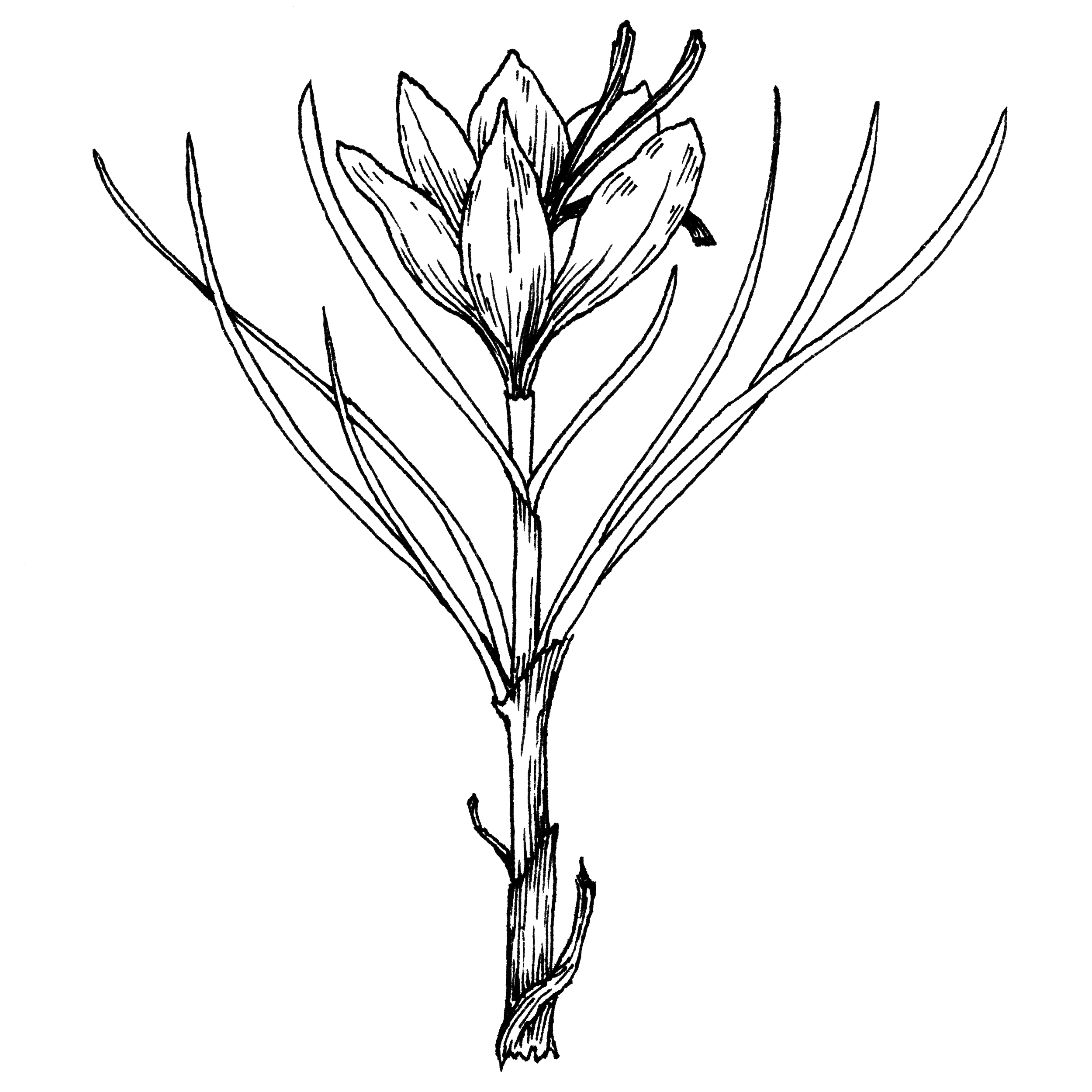
Plantcestor: Saffron, zaafaran, زعفران (Arabic), zaafran, Զաֆրան (Armenian), Crocus sativus
Plant family: Iridicieae
Parts used: Stamen
Energetics: Drying, warming
Herbal Actions: Aphrodisiac, anti-oxidant, expectorant, sedative, emmenagogue, adaptogen, anti-cancer, diaphoretic, nootropic, aromatic, bitter, anti-septic, anti-spasmodic, carminative, diuretic, tonic, anti-depressant, anti-anxiety, and stimulant.
Constituents: Crocin, crocetin, picrocrocin, safranal, zeaxanthin, lycopene, beta-carotene, riboflavin.
Contraindications: Use caution if experiencing low blood pressure or taking blood thinners. Avoid medicinal doses during pregnancy (culinary use is typically safe). People with certain pollen allergies or a high tendency towards multiple food allergies in general may have a reaction to saffron (particularly those with allergies to Iridaceae family, olive tree pollen, grass pollens, or plants containing lipid transfer proteins such as melon, cantaloupe, peach, or apple are higher risk).
SAFFRON AND THE BODY SYSTEMS
CARDIOVASCULAR & CIRCULATORY: Used to support the heart, balance blood sugar, and lower blood pressure and cholesterol. Diaphoretic (induces sweating).
COGNITIVE & NEUROLOGICAL: Nootropic - enhances cognition and memory. Supporting the brain aiding overall neurological health and addressing symptoms of Alzheimer’s. Crocin, the active compound in saffron helps fight degenerative neurological diseases. Effective adjunct and single treatment for ADHD and generally supporting mental focus. Epilepsy and adjunct for schitzophrenia (non-psychotic symptoms).
DIGESTIVE: Supports digestion by reducing inflammation and protecting the stomach lining. Can be helpful in IBS, IBD, and gastritis. Acts as a prebiotic.
MUSCO-SKELETAL: Pain relief. Works on smooth muscles, arthritis, and nerve pain.
NERVOUS SYSTEM: Used in treatment of mild and moderate depression and anxiety. Eases insomnia and mood disorders. Some studies show potential in supporting treatment of PTSD. Supports hormonal imbalances via regulating neurotransmitters (serotonin, dopamine, norepinephrine) and modulating the hypothalamic-pituitary-gonodal (HPG) axis.
SEXUAL & REPRODUCTIVE: Aphrodisiac - reverses sexual dysfunction induced by the use of antidepressants. Best if used in conjunction with vitamin E for this purpose. Studies showed a 55% increase in erectile function in men & 37% increase in general sexual satisfaction, and 62% overall improvement in sexual function for women - supporting vaginal lubrication, arousal, and general desire. Regulates menstrual cycle, eases PMS, PMDD, dysmenorrhea (period pain), Polyendocrine Metabolic Ovarian Syndrome (formerly PCOS), and endometriosis. Promotes fertility, increases sperm count, and used in treatment of sexual disorders. Supreme for postpartum and menstrual related depression and anxiety, uplifting the mood and activating the senses while supporting hormonal balance and relief of pain. Stimulates uterine contractions. Can support cervical ripening, reduce labor pain and anxiety, and reduce the duration of active labor (taken only after 37 weeks).
RESPIRATORY: Treatment of asthma, COPD, widens airways, clears mucus. Bronchitis, common cold.
IMMUNE SYSTEM: Immunomodulator. Antimicrobial. Supportive in cancer treatment of various kinds - inhibiting tumor growth and metastasis, neutralizing free radicals, reducing inflammation and oxidative stress. Anti-histamine - mast cell stabilization.
EYES: Improves eyesight and general protection of the eyes.
SKIN: Photoprotective UV absorber - can increase SPF in skin formulas, reduce hyperpigmentation, melasma, acne, and skin aging, reduce wrinkles, preserve skin elasticity and skin hydration, accelerate wound healing, promote collagen production and hyaluronic acid synthesis.
TRADITIONAL USES
Used as a botanical dye - it imbues everything it touches with a sunny yellow tint. After Buddha’s death, it was used to dye Buddhist priests robes across India.
Used in the old world perfumery traditions and cosmetics.
Saffron features as a common ingredient in most Iranian dishes as well as several Mediterranean ones, particularly in rice dishes and sometimes desserts.
Bedouin communities of Palestine mix it with honey and take it every morning for a week to ease cold induced inflammation in the uterus afterbirth. It is also used by them as a sedative during labor, and to treat menstrual disorders, constipation, and sexual impotence.
In Canaan, not only the stamens but the leaves and flowers are used as a tea for the treatment of depression, impotence, and infertility. Various species are collected by women across Lebanon and Syria to treat menstrual disorders including abnormal bleeding as well as delayed bleeding .
Villages in Lebanon using its flowers or leaves to treat children as a tea at the onset of infections such as mumps, chicken-pox, or the measles.
Was sought widely to treat the plague in Europe - brought to Spain by the Arab Moors.
Ibn Sinna (Avicenna) saffron is prescribed it for treating melancholy, heart strength, and digestive health.
In Sufi medicine traditions, supports illumination of the heart, sharpens inner and outer vision, lends protection and clarity against negative spirits and discharges the impact of grief and trauma from the spirit and heart. It can be mixed with rosewater or amber oil in zikr (remembrance) rituals.
Kashmiri traditions bathe their brides in saffron for spiritual purification and divine blessings before marriage.
FOLKLORE & COSMOLOGY
Pharaohs used saffron as a flavoring agent and aphrodisiac.
Cleopatra used it in baths to make lovemaking more pleasurable.
In Persian mythology, saffron was created from the tears of the hero Kaveh, who led a revolt against an evil king. Also used by the goddess Anahita (goddess of fertility, water, health and beauty) to heal the sick and the wounded.
In Islam, it is considered a barakeh (blessing). The Prophet Muhammad describes the soil of Paradise (heaven, so to speak) as being made of saffron, and the companions of Paradise as being made of musk and saffron. A celestially blessed spice associated with purity and spiritual light.
The creation story of saffron features in a Greek Myth involving Hermes, with various versions shared below:
Krocus (aka saffron) is the name of a mortal man who accompanied the greek messenger god Hermes. They were practicing discus on Mount Olympia when Hermes accidentally struck his friend in the head, causing a fatal injury. Hermes felt so bad that he transformed Krocus into a purple flower (saffron), granting him immortality. 3 drops of Krocus’ blood dripped to the center of the flower, creating the precious red stamens that make the spice we know today.
In another version of the story, Hermes uses the saffron flower to heal his injuries.
In yet another alternative Greek story shared below, you will notice variations reminiscent of the famous Canaanite myth of Adonis, in which he is attacked by a wild boar while hunting, and the goddess of beauty and fertility Ashtarte, his heartbroken beloved, turns his bleeding severed body into the red anemones and poppy flowers that fill the fields of spring. The story of Krocus and Smilax shared below also reminisces the version of this cosmological tale coming out of Saida, in which the goddess Ashtarte pursues the young hunter Eshmoon relentlessly until he gets overwhelmed by her and mutilates his body with an axe. In her grief, she transforms him into the immortal god of healing and seasonal renewal, Eshmoon. In other cities, associated as Tammuz (the word for July), and associated with vegetation, the revival of plants and the possibilities of life each spring and then “dying” again in July (Tammuz). These stories all speak of the cycles of death and rebirth, grief and healing, of desire and pursuit sometimes unrequited. The Greek versions are as follows…
A few other relevant cultural stories involving saffron are synthesized below from HerbClip Online:
The Crocus species (Iridaceae) have been associated with many myths and rituals in a variety of cultures.1 Native to the island of Crete, trade routes carried the plant to India where, before it became synonymous with the robes of Buddhist monks and nuns, the flower was associated with various goddesses, including Khamedenu, Sarasvati, and Gauri.
In the Hellenistic world Krokos, was a Spartan mortal, and fertility daemon, who appears as a lover to both the god Hermes and the nymph Smilax.1,2 In the Hermes myths, the god accidently wounds his lover with a discus or quoit, and Krokos perishes. Where his blood falls, the saffron flower grows with the three red styles containing his blood. Various renditions appear in the myths of Krokos and Smilax, whose name was given to a genus that includes a vining sarsaparilla greenbrier plant. One account tells of Smilax’s pursuit of Krokos, but he is uninterested. Like Echo, Smilax wastes away, with Aphrodite turning her into a greenbrier whose flowers have the scent of carrion and berries are as dark as night. In other versions, Krokos was heartbroken when his beloved Smilax died, and the gods took pity on him, turning him into the saffron flower and Smilax into an evergreen yew tree. Another version has Krokos wasting away spurned in his affections for Smilax and morphing into the flower, while Smilax’s punishment was to be turned into the sarsaparilla vine. Both saffron and the greenbrier sarsaparilla vine have been associated with aphrodisiac tendencies, and the sarsaparilla vine was used to treat venereal diseases.
Crocus flowers were also associated with the Eleusinian mysteries.1,3 Demeter, seeing golden crocuses (possibly C. chrysantus) grew angry that any plant would flourish while her daughter was in the Underworld, to which the crocuses responded, “The maiden is coming.” Thrilled, Demeter adorned herself with a mantle of white crocuses. While many versions of the Persephone myth have her gathering narcissus (Amaryllidaceae) or one of its cousins, according to Homer, the flower in question was a saffron, probably C. cartwrightianus, which blooms in the fall. In the versions where crocus predominates, the crocus flower would symbolize both death (the saffron that is the spice) and rebirth (the golden crocus which harbingers renewal and joy).
Eos, or Aurora, is the Greek goddess most associated with the saffron crocus.1,4 Ovid referred to the goddess of dawn as “the Saffron Mother.” Other writers mentioned her rosy-red (saffron-dyed) fingers. Her golden robes were embroidered with “flowery cloth” according to The Odyssey. The Illiad states that Eos places her saffron robes upon the earth in a protective measure. Eos is a liminal goddess existing in between night and day, so she harmonizes fire (sun) and water (dew). Eos is also a goddess of war, wisdom, and desire, who lustily took many lovers. Patriarchal interpretations portrayed these amorous pursuits as a goddess out of control and a kidnapper of mortal men; however, the aphrodisiac quality of the spice with which she is linked demonstrates the connections between desire, love, and the empowered feminine.
Lori Glenn
HerbClip™ Managing EditorReferences
1 Ancient cultic associations of saffron crocus. Paghat website. Accessed September 23, 2021. http://www.paghat.com/saffronmyth.html.
2 Quatermain C. Crocus in Greek mythology. Greek legends and myths website. October 13, 2019. Accessed September 23, 2021. https://www.greeklegendsandmyths.com/crocus.html.
3 Abduction of Persephone. Old European Culture website. April 9, 2020. Accessed September 23, 2021. https://oldeuropeanculture.blogspot.com/2020/04/abduction-of-persephone.html.
4 Harris E. A tale of two goddesses and saffron. Modern Salt website. August 28, 2016. Accessed September 23, 2021. http://www.modernsalt.co.uk/stories/a-tale-of-two-goddesses-and-saffron.
Homer frequently mentioned saffron in relationship to the “saffron-robed” goddess of the dawn Eos.
In Hindu mythology, saffron is associated with Lord Vishnu and symbolizes purity, courage, and sacrifice.
ECOLOGY AND CULTIVATION
There are crocus species native all across the Mediterranean and the Crossroads regions. Crocus sativus is likely a descendent from the species Crocus cartwrightianus, which was native to Crete, where it was first domesticated in the late Bronze age. By 500 BC, cultivation also spread from Persia to India.
It has been cultivated and used medicinally for more than 3,600 years.
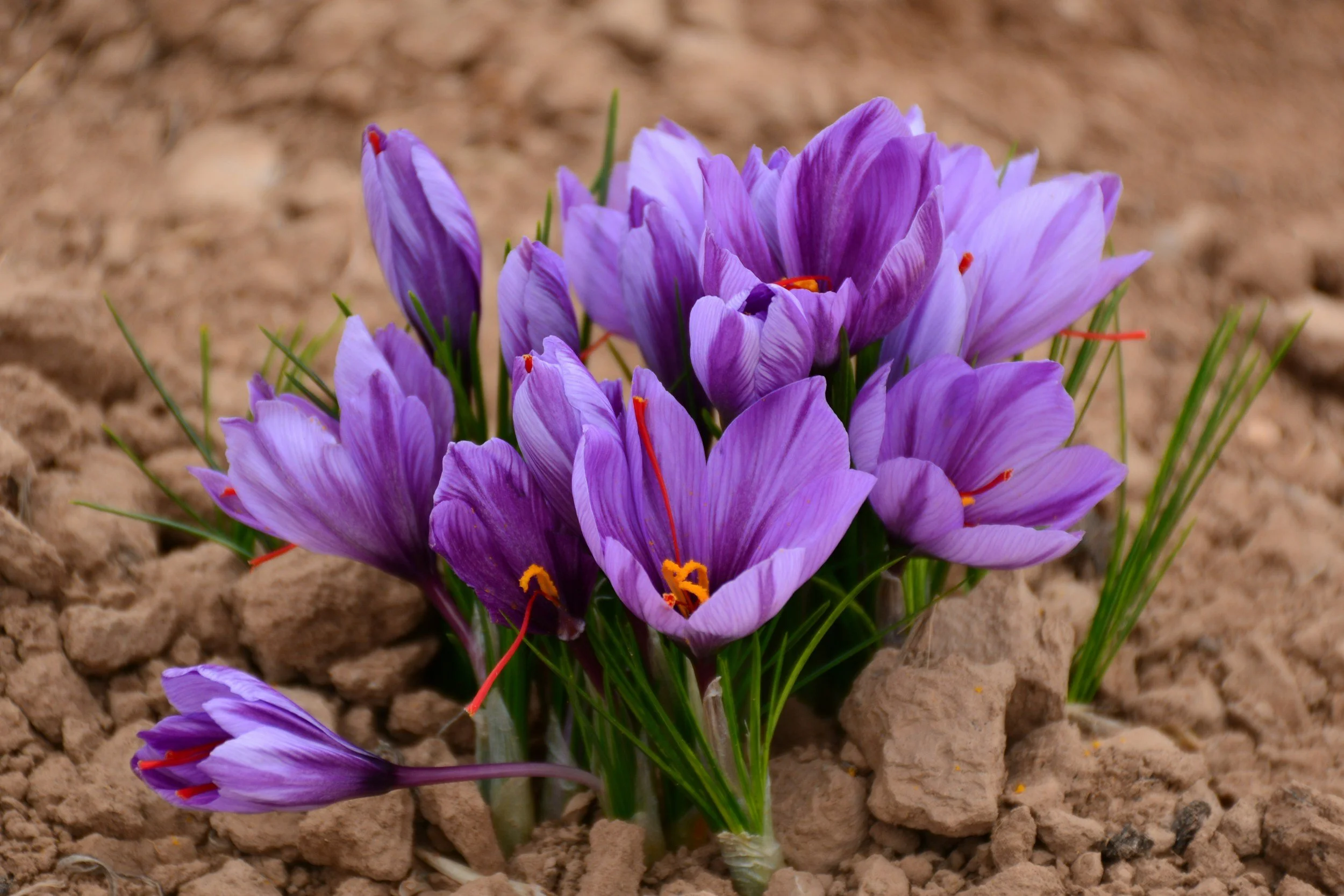
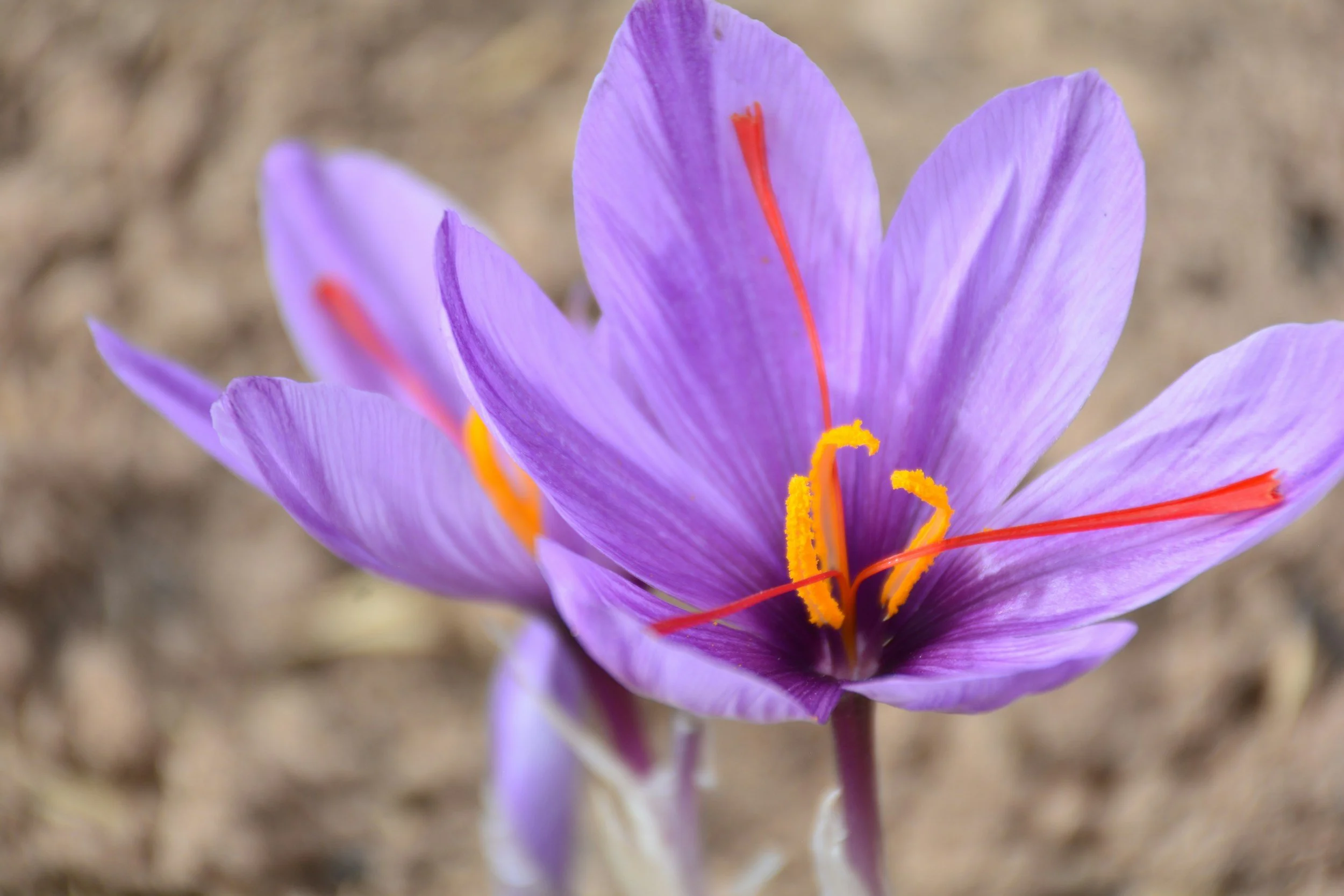
Saffron crocus is planted from corms. The corms are small, flattened at the base, and are coated in thin fibers. The flower blooms into an iris-shaped deep purple flower.
Saffron crocus is a low-growing fragrant flower which blooms in Autumn.
Crocus sativus does not grow wild, it is only produced through cultivation.
Cultivation:
Crocus rarely develops seeds and they are typically not viable. Saffron is usually planted from its corms.
Can grow in a wide range of environments.
Cultivated in rows in light soil in midsummer.
Flower about 40 days later, in early autumn. Flower for around 15 days.
Harvesting:
Crocus are a fall blooming flower whose harvest typically takes place around November.
One of the most precious and expensive spices in the world due to the labor-intensive harvesting process. Requires hand picking the few red threads in each flower (about 150 flowers for 1 gram of saffron).
In Greece, flowers are harvested throughout the day as demanded by flowering, while in Italy, flowers are harvested early in the morning while the flower is closed, and after the dew has evaporated (Deo, 2003). In India, saffron crocuses are picked in the morning while half open (Svoboda, 1992). Generally, the flowerheads are separated from the stems by cutting with the fingernail or by gently twisting them off, and they are immediately dried. In the ayurvedic tradition, flowers are gently dried on a slow fire before the threads are removed (Svoboda, 1992), but threads also can be dried in a dehydrator at 118 degrees F for 3 hours. Recent research shows that drying in an air flow of 158 degrees F is also effective (Deo, 2003). Whatever the method, overdrying saffron results in a poor-quality product. Once dry, saffron should be stored in the dark at low temperature and low humidity (Deo, 2003).
MEDICINAL AND CULINARY USES
30mg per day is studied for effective results for numerous conditions
If you want to take capsules, I like Triqueta brand. Otherwise, make sure to verify 3rd party testing or do proper research on the source and quality as it matters a lot with this plantcestor. Make sure both crocin and safranal extracts are present in their extracts. Please note that going over 30mg doses sometimes increases the likelihood of negative side effects, with no added benefit. I recommend sticking to 28-30mg for most conditions unless otherwise specified.
Tinctures are less precise as far as how many mg you are taking per drop, but they extract the wide range of constituents very effectively and are an effective form of administration. You can make your own at home (instructions in the link below). Alcohol doesn’t taste as pleasant but is a more complete extract than glycerine.
For raw strands, a small pinch is sufficient. Many people use only up to 5 strands. 15-20 strands typically amounts to about 30mg. In this form, consider splitting them into a morning and evening dose for best mood and sleep support.
For optimal extraction, grind the saffron in a mortar and pestle, and put an ice-cube on it to melt. This will “bloom” the saffron, turning the liquid a bright sunshine yellow. You can then add to food or drink. (Traditionally, this is done in warm water instead of ice. Some additional constituents are extracted with the cold method instead. If you use warm, make sure its not scalding.) You can add a pinch of salt or sugar to help grind it down more effectively.
Saffron Latte is my favorite way to take this medicine: add a bit of sweetener and your milk of choice for a cold or warm drink. I like to add cinnamon, ginger, clove, cinnamon, and cardamom for extra support and pleasure. I have made variations with matcha, cacao, ashwaganda, or tumeric for other kinds of support depending on my daily need. Enjoy your kitchen play!
You can also keep it traditional and add to rice dishes, desserts, and otherwise.
Note that constituents like crocin are water soluble, while safranal is fat soluble. So after blooming with water, adding fat like ghee, butter, or milk helps get the most out of this precious medicine. A pinch of black pepper can also help.
If you are interested in more precise instructions and other forms of extracting saffron such as making your own alcohol tinctures, I highly recommend you take a look at this page for pertinent and accessible information around how to treat this beautiful medicine. I agree with it’s recommendations and have had a lot of success using alcohol tinctures in my formulations. This may be a more economical home alternative to using capsules.
SOURCING SAFFRON
Kashmiri saffron is particularly sought for its quality. Diaspora Spice Co. is a brilliant aligned company with ethical business practices, homeland farm connections, and supreme quality spices. They offer us a special discount code: RIVERROSE.